
When the Supermarket Says No, What Happens Next?
A few weeks ago, we wrote about this summer's heat in our box letter. Hot, dry weather brought a wave of misshapes, gluts, shortages, pest damage and more, which meant supermarkets were turning away whole orders of otherwise good veg.
One Oddboxer wrote back with some very big questions. If supermarkets reject fruit and veg, how do they fill their shelves at short notice? Do they order too much on purpose? And how much impact does Oddbox have on this waste?
As the Oddboxer wrote, so many of us know so little about how our food reaches our plate, so let’s try and lift the lid a little.


How do supermarkets buy fruit and veg?
Supermarkets don’t often buy straight from a single farm. Most fresh produce reaches the shops through large suppliers, often called packers. A packer gathers crops from its own fields, as well as from contracted growers across the country and from abroad. They then wash, grade, pack and deliver them to the supermarket warehouse. When I’ve visited packers before, you can see the fruit and veg being packaged up with each specific supermarket branding, under one roof.
Most of the time, growers and packers reach an agreement for how much volume (aka how much fruit or veg) will be provided across the season, but this is hard to predict. It can easily vary, as nature has a tendency to do, with growers producing too much, too little, or none at all.
Supermarkets can change their plans too. Their orders go up and down with the weather, special offers and what other suppliers are charging. As the biggest players in the metaphorical ‘food chain’, they tend to call the shots. When a supermarket reduces or cancels an order with a packer, the packer usually takes less from its growers. And that's how a grower can suddenly find themselves with pallets of perfectly good fruit and veg, but nowhere to send them.
What happens after fruit and veg is rejected
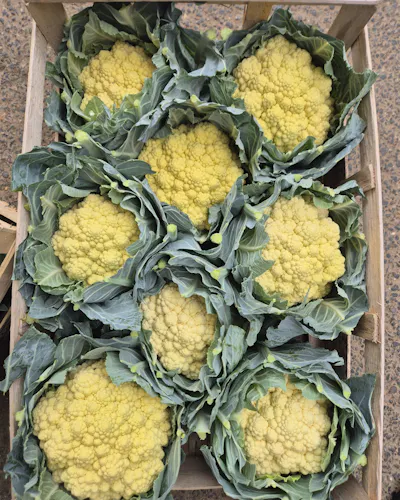
Most rejections happen at the packhouse before going to the supermarket. Each crop is checked against the supermarket's specifications: size, shape, colour, blemishes. For example, cauliflower tinged yellow from the intense sun and heat won’t pass these checks, even though it still tastes perfectly good. That explains why we rescued 6,000 heads of cauliflower in a single week in August, after weeks of blinding sunshine.
When crops are rejected, the packer has a few ways to fill the gap to make sure no supermarket shelves go empty:
- Another grower. Packers buy from multiple growers, often across different regions. One grower's bad week can be covered by another's good one.
- Imports. The UK grows just 53% of its own fresh veg and 16% of its fresh fruit. Spain and the Netherlands alone supply over half our veg imports, so switching to another country is common if there are issues at home.
- Extra crops already in the ground. This is the part that surprises people. Most growers plant more than the packer has asked for — often a good chunk more. It's their insurance policy: if pests, a heatwave or a sudden order change knock out part of the crop, they can still deliver what they promised. And because contracts tend to leave that risk with the grower, not the supermarket, it's the grower who has to plan for it. So when one farm's crop is rejected, there's usually spare produce on another farm, ready to pick.
Our Oddboxer asked if supermarkets order too much and turn some down as a matter of course. She's not far off. It's just that the extra is usually planted by growers, not ordered by supermarkets. That built-in cushion is how shelves stay full. It's also where a lot of good food ends up at risk of going to waste.
But if the whole supply is affected by a common issue, supermarkets can actually relax their specs to ensure that produce still reaches their shelves. So it’s interesting that when it suits them, they’re able to flex their specs to help growers – but they don’t do this year-round. We bought some courgettes from a major supermarket over the summer, and when we compared them to the veg in our boxes, we found they were every bit as wonky. If the specs can bend in a crisis, it's fair to ask whether they need to be quite so strict the rest of the year.
Do shelves ever go empty?
Remember early 2023, when bad weather in Spain and North Africa led some supermarkets to police how many tomatoes and cucumbers you could buy? Supermarkets track buying habits down to the last detail, so gaps on shelves are rare, but they do happen.
When there are shortages, supermarkets can, on the whole, spread a shortfall across all their shops to help soften the blow. Produce goes from packers to big regional distribution centres, then out to stores. It's very centralised, so things can be rejigged to make up for any shortages as much as possible. Due to this, the food system relies on massive volumes of fruit and veg that all look the same. Plenty, as we know, don’t fit into this system.
Where does rejected fruit and veg go?
There are a few places a rejected crop might end up:
- With rescuers like us or in a supermarket's own 'wonky' range.
- Sold through wholesale markets and discounters.
- Chopped into soups, ready meals or juice.
- With food charities such as FareShare and City Harvest.
- As animal feed.
- In an anaerobic digester, which turns food into energy and fertiliser.
- Ploughed back into the field, or never harvested at all.
The higher up the list, the more of the farmer's work (and the food) gets used. We like to catch as much as we can near the top.
How big is the problem, and where do we fit in?
The UK wastes around 10.2 million tonnes of food a year according to WRAP. Most of it is in our homes, but farms come second.
Shops look like they barely waste anything, but it’s actually a lot more complicated than that. Rejected produce never reaches them, so it's counted as waste on the farm instead.
WRAP's most recent report found 3.6 million tonnes of surplus and waste each year on farms; about 7% of everything grown and reared in the UK. Of that, 2 million tonnes was surplus – essentially, food that’s still perfectly good to eat.
So where do we fit into everything? In ten years, our community has helped us rescue more than 68,000 tonnes of fruit and veg from around 110 growers. There’s no doubt this makes a huge difference. But measured against 2 million tonnes of surplus every year, it's clear there’s still a lot of work to do.
Is anything changing?
A little. The government and some industry bodies have been trying to help even out the relationship between growers and packers, to save growers from being left in the lurch with last-minute changes. Growers who sell straight to supermarkets are protected by the Groceries Code, but most sell through packers, so they’re still vulnerable. In short, there isn’t a whole load that’s changing.
Something else to consider is the murkiness in this world of waste. For years, there have been calls for large food businesses to be required to measure and report their waste, but it still isn’t mandatory. More transparency across the whole food system, and being able to trace who is wasting what with greater accuracy, might encourage more action.
In the meantime, every Oddbox you receive helps growers everywhere. It gives them somewhere to send crops that are “too odd” or “too many”, and it gives those crops a second chance at your dinner table. Thanks for all your hard work.

